
Explore Minnesota's Mineral Resources
Minnesota's Archean and Paleoproterozoic geology, extensive public geoscience data, skilled workforce, established infrastructure, and public land stewardship support informed mineral-related research, exploration, development, and long-term resource management across the state.
Mineral Systems
Minnesota hosts several well-defined mineral systems within the southern extension of the Canadian Shield of Ontario and Québec, an area proven to host a wide range of critical and industrial mineral systems.
Key mineral systems include:
- Iron formation-hosted systems of the Lake Superior region, supporting more than 140 years of continuous iron mining.
- Mafic and ultramafic intrusions related to the Midcontinent Rift hosting nickel, copper, platinum-group elements, and titanium; and emerging commodities such as helium.
- Greenstone belt-hosted systems within Archean terranes associated with gold mineralization.
Recent exploration campaigns have documented mineral occurrences of notable scientific significance, resulting in representative specimens being accepted for curation by the Smithsonian Institution and the Royal Ontario Museum.
Infrastructure and Workforce
With a 140-year history of continuous mining, Minnesota has well-developed networks of transportation, power, and industrial infrastructure that supports mineral-related activity across the state. Rail, highway, port, and utility systems, particularly along the Lake Superior region, connect mineral-producing areas to regional, national, and international markets.
Minnesota also benefits from a skilled and experienced workforce with expertise in geology, engineering, environmental science, and the skilled trades. Iron mining has fostered the growth of mining-related industries and a broad supplier base. The taconite mining industry alone purchases goods and services from hundreds of supplier and vendor businesses across more than 200 Minnesota communities, supporting a diverse ecosystem of technical, manufacturing, and professional services.

Public Data & Research

Minnesota's long-term public investments in geoscience data and research infrastructure support mineral management, coordination, and planning.
A cornerstone of this effort is the Minnesota Drill Core Library, a single, centralized state-managed facility which preserves over three million feet of drill core collected across the state, along with associated drill logs and location data.
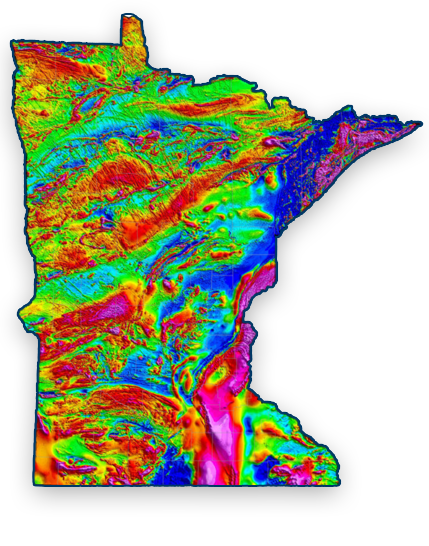
Minnesota also maintains the Minnesota Mineral Resource Database (MMRD), a compilation of more than 100 years of mineral exploration and production documents. MMRD integrates data from historical records, assay data, exploration activities, and public datasets to support mineral systems analysis and resource understanding. The Minnesota Geological Survey (MGS) publishes statewide geologic maps and high-resolution geophysical datasets, including aeromagnetic data, available in digital formats.
Public Lands & Stewardship
Minnesota manages a substantial public mineral estate, administering mineral rights on nearly 12 million acres, primarily in northern Minnesota. The state does not use a claim-staking system; instead, mineral rights on state-owned lands are made available through a structured leasing process administered by the DNR. Leases are typically awarded through competitive bidding based on royalty terms, with additional mechanisms available in areas that do not receive competitive bids. These state-administered mineral interests are distributed across northern Minnesota and are supported by existing transportation access. State mineral leases are structured to support long-term planning, environmental review, and responsible mineral stewardship.
Minnesota also includes extensive areas of privately held mineral rights, where mineral access and development occur through private agreements. In combination, public and private mineral ownership, established leasing processes, and environmental standards support mineral exploration while enabling coordinated stewardship, informed decision-making, and long-term management across the state.
